morphology pose
8 morphology poses
| Poses | Meaning |
|---|---|
| circular_000 | Hip rotation at approximately 0° |
| circular_030 | Mirrored hip rotations at ±30° |
| circular_060 | Mirrored hip rotations at ±60° |
| circular_090 | Mirrored hip rotations at ±90° |
| knees_axial_outward | Knees pointing outward along the body axis |
| knees_axial_inward | Knees pointing inward along the body axis |
| knees_radial_outward | Knees pointing radially away from body center |
| knees_radial_inward | Knees pointing radially toward body center |
Stiffness&Damping
Static Stiffness
Static Damping
Each joint is independently approximated as a second-order system:
Undamped natural angular frequency:
Undamped natural frequency in hertz:
Critical damping coefficient:
Damping ratio:
Given
where
: joint inertia when the base and all other generalized coordinates are locked. : effective joint inertia when the base and all other joints are free. The other generalized coordinates are unforced and allowed to move through dynamic coupling.
Calculation:
q_allow = 5° = 0.0872664626 rad
zeta = 1.0
J_eff = locked
| Joint Family | ||
|---|---|---|
| hip_flexion | 0.428391–53.2874 | 0.276606–3.70349 |
| hip_abduction | 0.0329987–50.4153 | 0.0803375–3.38429 |
| hip_rotation | 0.278956–37.1817 | 0.104658–1.20771 |
| knee_flexion | 24.7168–102.117 | 0.959010–1.94929 |
Selected upper-bound gains:
- Hip:
, - Knee:
,
IsaacSim DCMotor
DC Motor in Isaac Lab
| # | Parameter | Description | Unit | ||
|---|---|---|---|---|---|
| 1 | stiffness |
Position-control gain |
N·m/rad | 50.0 | 100.0 |
| 2 | damping |
Velocity-feedback damping gain |
N·m/(rad/s) | 3.38 | 1.95 |
| 3 | armature |
Rotor inertia reflected to the output shaft | kg·m² | 0.0012484886 | 0.0012484886 |
| 4 | friction |
Static/breakaway friction torque | N·m | 0.2384994984 | 0.1074789484 |
| 5 | dynamic_friction |
Coulomb friction torque during motion | N·m | 0.00126407998 | 0.000537669324 |
| 6 | viscous_friction |
Viscous friction coefficient | N·m/(rad/s) | 2.3799067e-5 | 1.0411770e-5 |
| 7 | effort_limit |
Continuous output torque limit | N·m | 36.0 | 36.0 |
| 8 | saturation_effort |
Stall/saturation torque | N·m | 72.0 | 72.0 |
| 9 | velocity_limit |
No-load speed limit | rad/s | 53.0 | 53.0 |
Torque control:
Effort/velocity
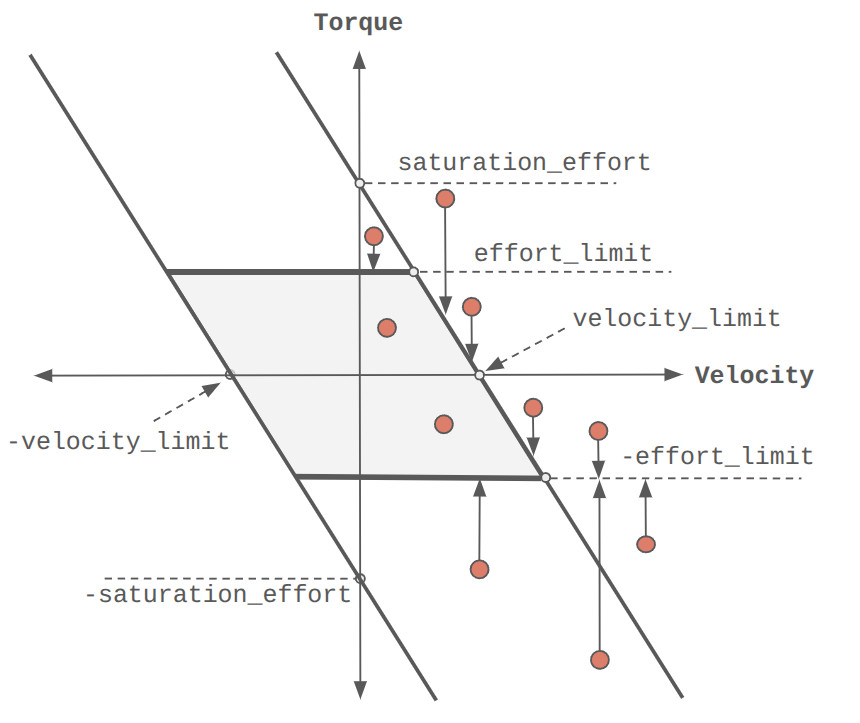
For positive torque, the torque–speed envelope is defined by:
Based on the RS 06 torque–speed curve, the desired characteristics are:
- A peak torque of approximately 36 N·m at low speeds.
- Torque remaining near its peak up to approximately 250 rpm.
- Torque decreasing to nearly zero at approximately 510 rpm.
Accordingly, the following parameter values can be used:
effort_limit=36.0,
saturation_effort=72.0,
velocity_limit=53.0,    # rad/s = RPM * 2 * pi / 60
Motor rotor armature
- Axial length:
h=25 mm - Outer radius:
r_o=15 mm - Inner radius:
r_i=5 mm - Effective density:
ρ=7850 kg/m³ - Gear reduction ratio:
N=9
Calculate:
  "assumptions": {
    "axial_length_m": 0.025,
    "outer_radius_m": 0.015,
    "inner_radius_m": 0.005,
    "equivalent_density_kg_m3": 7850.0,
    "gear_ratio_motor_speed_per_output_speed": 9.0
  },
  "calculation": {
    "mass_expression": "rho*pi*h*(r_outer^2-r_inner^2)",
    "rotor_inertia_expression": "0.5*mass*(r_outer^2+r_inner^2)",
    "output_side_expression": "rotor_inertia*gear_ratio^2",
    "equivalent_mass_kg": 0.12330751165392173,
    "rotor_inertia_kg_m2": 1.541343895674022e-05,
    "output_side_armature_kg_m2": 0.001248488555495958
  },
Motor parameter identification
Payload model
两个模型的底座相同:
- 底座质量:
0.5282673472 kg - 底座质心:
[0.0002567991, -0.0000035019, 0.0202477424] m - 底座惯量:
Ixx=0.0004119872、Iyy=0.0004178833、Izz=0.0005423930 kg·m²
2.1 负载平衡模型
- Payload 质量:
2.4072134493 kg - 质心:
[-4.14334e-6, -1.51857e-5, -0.04553585] m Ixx = 0.05500499938 kg·m²Iyy = 0.003552246411 kg·m²Izz = 0.05767903458 kg·m²Ixy = 1.54564e-6 kg·m²Ixz = 1.93840e-7 kg·m²Iyz = 7.59740e-7 kg·m²- 按平行轴定理换算到关节 Z 轴:约
0.05767903518 kg·m² - q=0 附近重力矩:约
0.0003586 N·m,基本平衡
2.2 单边负载模型
- Payload 质量:
1.4082332749 kg - 质心:
[9.95192e-6, -0.1064336763, -0.0424325965] m - 质心到关节轴的径向距离:约
0.106434 m Ixx = 0.01485312262 kg·m²Iyy = 0.001884312992 kg·m²Izz = 0.01611149247 kg·m²Ixy = -3.54392e-6 kg·m²Ixz = -2.59302e-7 kg·m²Iyz = -0.001119882209 kg·m²- 按平行轴定理换算到关节 Z 轴:约
0.03206413861 kg·m² - q=0 最大重力矩:约
1.4703566 N·m
Optimization
Optimized parameters: friction, dynamic_friction, and viscous_friction.
Parameter bounds:
friction:N·m - Dynamic-to-static friction ratio:
viscous_friction:N·m/(rad/s)
Log-space normalization:
Objective Function
The position root-mean-square error (RMSE) for each trajectory is defined as:
The Huber loss function is defined as:
The velocity-error term is defined as:
The final objective function is:
Data
| ID | Trajectory Name | Trajectory Profile | Primary Purpose | Use in the Current Standard Workflow |
|---|---|---|---|---|
| R01 | balance_holds |
Holds at |
Evaluate load balancing, static bias, holding error, and breakaway/static friction | Fit |
| R02 | micro_sines |
Low-amplitude sinusoids of 0.01/0.03/0.06 rad at 0.1/0.2/0.4 Hz | Excite breakaway friction, dead zones, small-signal tracking, and stick–slip behavior | Fit |
| R03 | multiscale_smooth_steps |
Multiscale smooth steps of 0.25/0.5/1.0 rad | Evaluate control latency, effective |
Fit |
| R04 | rounded_triangle |
Rounded triangular wave, ±0.2 rad at 0.05 Hz | Excite low-speed friction, direction reversals, hysteresis, and backlash | Fit |
| R05 | wide_constant_velocity_round_trips |
Bidirectional constant-velocity sweeps at 0.1–4.0 rad/s | Distinguish static friction, dynamic Coulomb friction, and velocity-dependent resistance | Fit |
| R06 | wide_minimum_jerk_acceleration_sweeps |
Large-amplitude minimum-jerk motions of ±0.8 rad with varying durations | Excite armature inertia, load inertia, and acceleration dynamics |
Fit |
| R07 | variable_amplitude_log_chirp_up |
Upward logarithmic chirp from 0.1 to 3.0 Hz with frequency-dependent amplitude | Characterize broadband closed-loop dynamics and magnitude/phase responses | Fit |
| R08 | variable_amplitude_log_chirp_down |
Downward logarithmic chirp from 3.0 to 0.1 Hz | Evaluate sweep-direction dependence, thermal drift, hysteresis, and time-varying effects | Fit |
| R09 | multisine_small |
Low-amplitude multisine excitation from 0.1 to 2.5 Hz, with a peak amplitude of approximately 0.15 rad | Provide small-to-moderate-amplitude broadband periodic excitation and evaluate the linear closed-loop response | Fit |
| R10 | multisine_large |
Same frequencies and phases as R09, with a peak amplitude of approximately 0.45 rad | Compare with R09 to identify amplitude-dependent nonlinearities | Fit |
| R11 | wide_filtered_binary_sequence |
Smoothed random binary switching with an amplitude of ±0.3 rad | Excite broadband dynamics, control latency, random direction reversals, and aperiodic residuals | Fit |
| R12 | held_out_sine_bank |
Multiple independent sinusoidal segments from 0.15 to 2.9 Hz, with amplitudes decreasing from 0.8 to 0.12 rad | Evaluate frequency points and large-amplitude responses not directly covered by the other trajectories | Promoted to Fit in the current standard workflow |
| R13 | smooth_clipped_sine |
Smoothly clipped 1 Hz sinusoid | Evaluate clipping nonlinearities, transition dynamics, and overall system generalization | Sole held-out validation trajectory |
| Trajectory | Name | Sample Count | Duration |
|---|---|---|---|
| R01 | balance_holds |
1,400 | 28.00 s |
| R02 | micro_sines |
3,075 | 61.50 s |
| R03 | multiscale_smooth_steps |
1,800 | 36.00 s |
| R04 | rounded_triangle |
2,000 | 40.00 s |
| R05 | wide_constant_velocity_round_trips |
6,103 | 122.06 s |
| R06 | wide_minimum_jerk_acceleration_sweeps |
1,372 | 27.44 s |
| R07 | variable_amplitude_log_chirp_up |
2,250 | 45.00 s |
| R08 | variable_amplitude_log_chirp_down |
2,250 | 45.00 s |
| R09 | multisine_small |
2,500 | 50.00 s |
| R10 | multisine_large |
2,500 | 50.00 s |
| R11 | wide_filtered_binary_sequence |
2,000 | 40.00 s |
| R12 | held_out_sine_bank |
4,556 | 91.12 s |
| R13 | smooth_clipped_sine |
1,250 | 25.00 s |
| 数据范围 | 单个 Kp 条件样本数 | 单个 Kp 条件时长 |
|---|---|---|
| R01–R11 | 27,250 | 545.00 s(9分05秒) |
| R12–R13 | 5,806 | 116.12 s(1分56.12秒) |
| R01–R12,当前 CMA fit | 31,806 | 636.12 s(10分36.12秒) |
| R13,held-out validation | 1,250 | 25.00 s |
| R01–R13 总计 | 33,056 | 661.12 s(11分01.12秒) |
Result
| Parameter | ||
|---|---|---|
armature (fixed) |
0.0012484886 | 0.0012484886 |
friction [N·m] |
0.2384994984 | 0.1074789484 |
dynamic_friction [N·m] |
0.00126407998 | 0.000537669324 |
| Dynamic-to-static friction ratio | 0.00530014 | 0.00500255 |
viscous_friction [N·m/(rad/s)] |
2.3799067e-5 | 1.0411770e-5 |
| Optimal objective value | 0.848628998 | 1.002159834 |
| Median fit RMSE [rad] | 0.00894282 | 0.01402229 |
| 90th-percentile fit RMSE [rad] | 0.02249461 | 0.03209888 |
| Fits with RMSE |
9/12 | 9/12 |
| R13 RMSE [rad] | 0.02581465 | 0.03185880 |
Final parameters
| # | Parameter | Description | Unit | ||
|---|---|---|---|---|---|
| 1 | stiffness |
Position-control gain |
N·m/rad | 50.0 | 100.0 |
| 2 | damping |
Velocity-feedback damping gain |
N·m/(rad/s) | 3.38 | 1.95 |
| 3 | armature |
Rotor inertia reflected to the output shaft | kg·m² | 0.0012484886 | 0.0012484886 |
| 4 | friction |
Static/breakaway friction torque | N·m | 0.2384994984 | 0.1074789484 |
| 5 | dynamic_friction |
Coulomb friction torque during motion | N·m | 0.00126407998 | 0.000537669324 |
| 6 | viscous_friction |
Viscous friction coefficient | N·m/(rad/s) | 2.3799067e-5 | 1.0411770e-5 |
| 7 | effort_limit |
Continuous output torque limit | N·m | 36.0 | 36.0 |
| 8 | saturation_effort |
Stall/saturation torque | N·m | 72.0 | 72.0 |
| 9 | velocity_limit |
No-load speed limit | rad/s | 53.0 | 53.0 |
DCMotorCfg(
    joint_names_expr=["hip"],
    stiffness=50.0,
    damping=3.38,
    armature=0.0012484886,
    friction=0.238499498429,
    dynamic_friction=0.00126407997987,
    viscous_friction=2.37990671357e-05,
    effort_limit=36.0,
    saturation_effort=72.0,
    velocity_limit=53.0,
)

DCMotorCfg(
    joint_names_expr=["knee"],
    stiffness=100.0,
    damping=1.95,
    armature=0.0012484886,
    friction=0.107478948424,
    dynamic_friction=0.000537669323874,
    viscous_friction=1.04117699332e-05,
    effort_limit=36.0,
    saturation_effort=72.0,
    velocity_limit=53.0,
)
Something interesting
- 低速的周期阻滞能识别出来
- 可能不只是滑动摩擦在影响电机表现:Translational Friction | AnyMath 文档 还可能有低速下的Shtribek摩擦