An interpretation
is any set of objects, called domain is a mapping called the interpretation mapping, from the (non logical) symbols to elements and relations over
Given a formula
- no matter how we will choose an interpretation, G is always true: G is a valid formula, or a tautology (⊨ G)
- no matter how we will choose an interpretation, G is always false: G is an inconsistent formula
- mind: invalid is different from inconsistent.
- More frequently, there will be formulas G that are invalid, bur are satisfiable (i.e., consistent).
logical consequence
Given a set of formulas
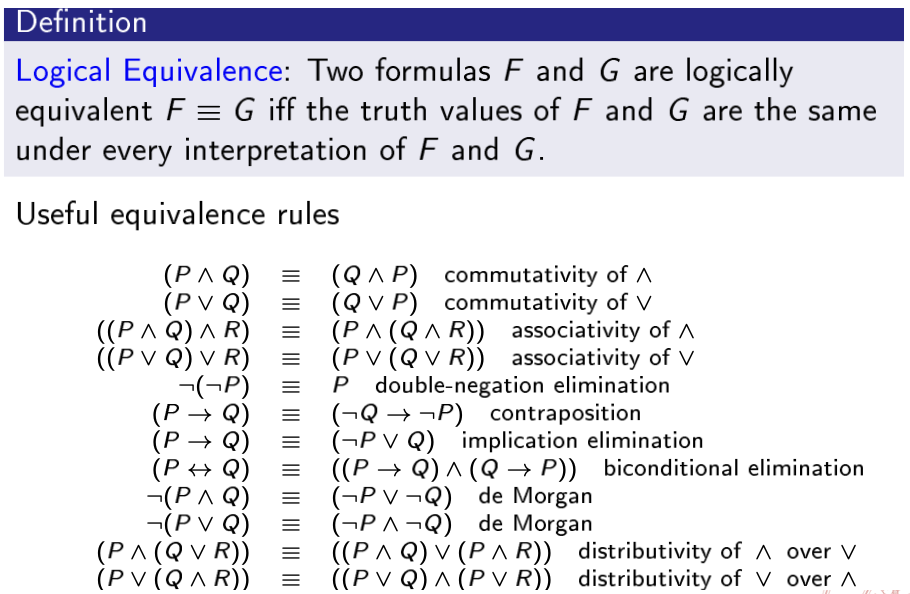
- Def.: Two formulas F and G are logically equivalent
- F ≡ G iff the truth values of F and G are the sameunder every interpretation of F and G
- F ≡ 𝑄 iff 𝐹 ⊨ 𝑄 and 𝑄 ⊨ 𝐹
logical equivalence
Refutation and Resolution
Reasoning by refutation
Theorem: Given a set of formulas {𝐹 !, … , 𝐹 # } and a formula G, 𝐹1 ∧ ⋯ ∧ 𝐹n ⊨ 𝐺 if and only if 𝐹 ! ∧ ⋯ ∧ 𝐹 # ∧ ¬𝐺 is inconsistent.
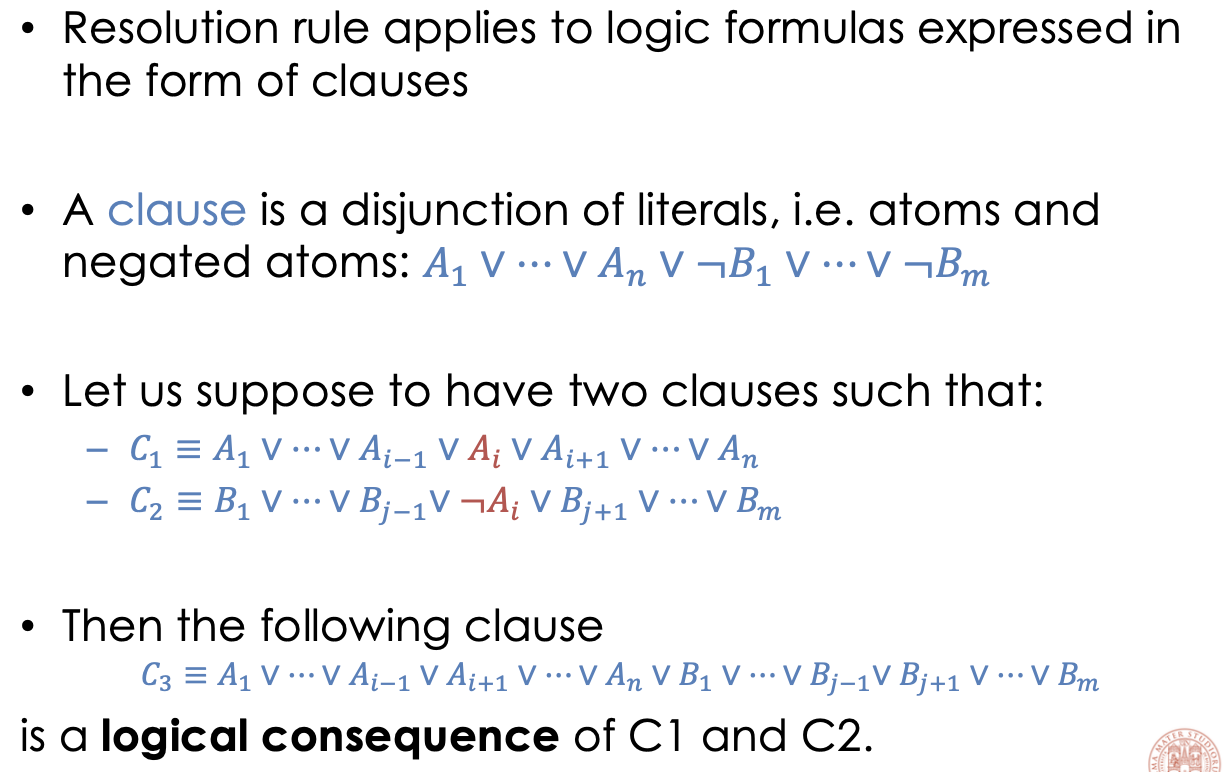
Resolution
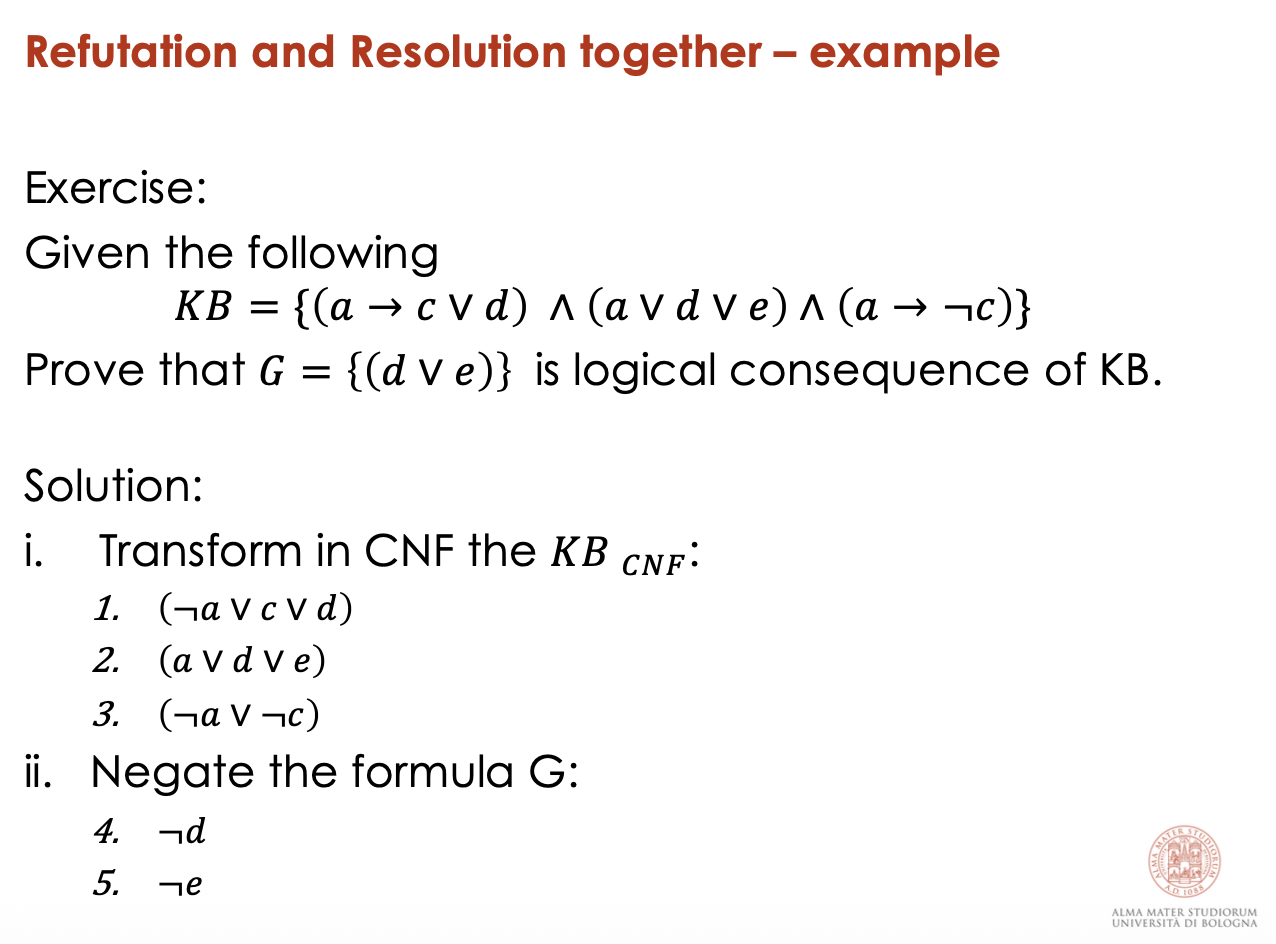
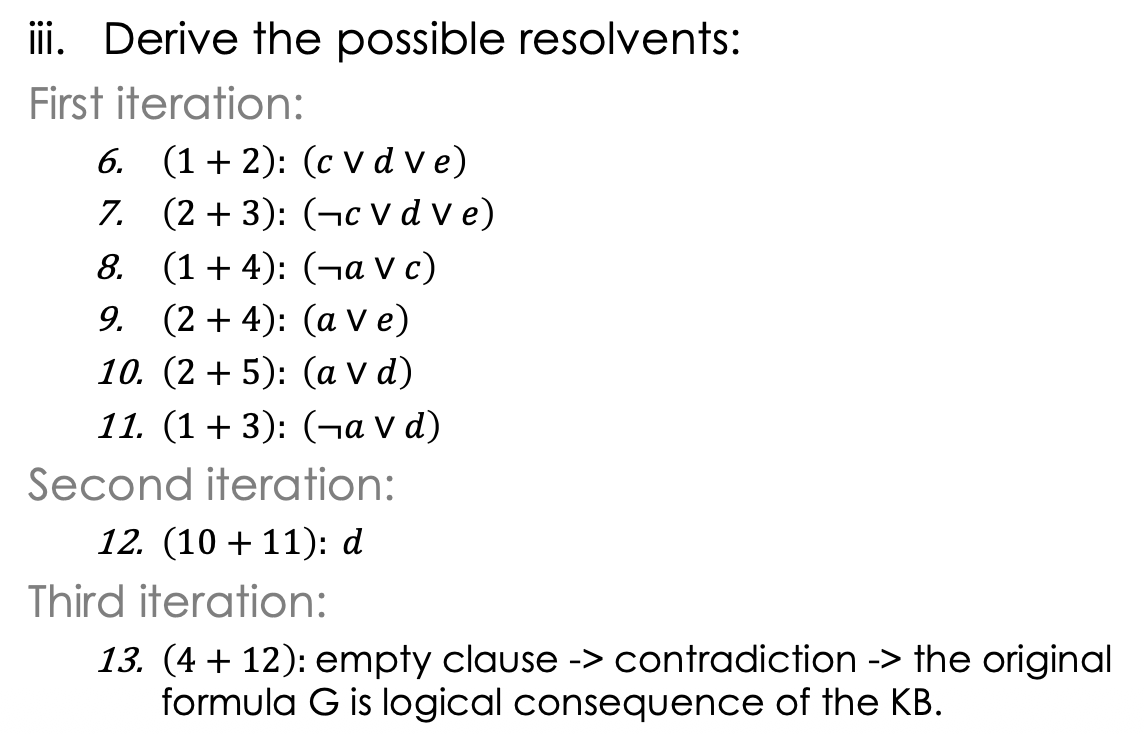
Refutation and Resolution together – practical steps
- Transform our knowledge base KB in CNF form: each conjunct will be a clause
- Negate the formula G and add it to the KB
- Apply the resolution principle (to all the clauses) until we reach the inconsistency